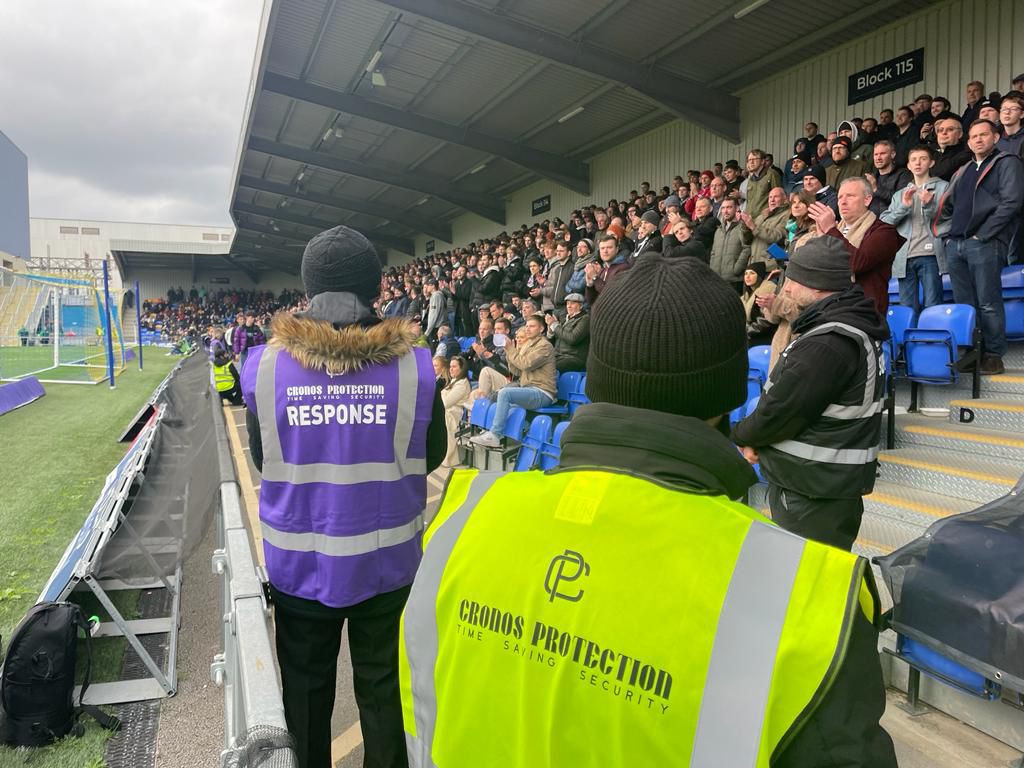
Anyone can print a polo shirt with a logo on it. Very few security companies can hand you an independent auditor's report on how they screen, train, supervise and record the work of the officers they put on your site. That is the gap COP 119 exists to close.
If you are comparing quotes for manned guarding, door supervision or event security, the code of practice a supplier works to is one of the fastest ways to separate a properly run company from a cheap one. This guide explains what COP 119 covers, how it sits alongside SIA licensing and ISO certification, and the specific questions to put to any provider bidding for your contract.
What COP 119 actually is
COP 119 is a code of practice for the provision of security services. A security company does not simply declare that it complies — it is assessed against the code by an independent certification body, and it has to keep evidencing compliance to retain certification.
In practice, a code of practice does three things that matter to a buyer:
It sets a written standard for how the service should be organised, not just delivered on the day.
It puts the burden of proof on the supplier: records, files, training matrices and audit trails have to exist and be produced on demand.
It gives you, the client, a reference point that is not the supplier's own marketing.
The areas a code of practice of this type concentrates on are the ones where corner-cutting is invisible until something goes wrong: vetting and screening of staff, licence checking, right-to-work verification, training and refresher training, assignment instructions, supervision and site visits, incident reporting, complaints handling, and the way records are stored and retained.
How COP 119 differs from an SIA licence
This is the most common confusion in the market, and the most expensive one.
An SIA licence belongs to the individual officer. It confirms that person has completed the required qualification and passed the Security Industry Authority's criminality and identity checks for their licensable role — door supervision, security guarding, CCTV operation, close protection. It says nothing at all about the company deploying them.
A code of practice applies to the company. It looks at whether the business behind the badge has systems: whether it checks that licences are still valid rather than valid at the point of hire, whether it screens staff beyond the SIA minimum, whether officers get site-specific briefings, whether anyone from management ever visits the site at 3am to confirm the officer is awake and on post.
Both matter. A licensed officer working for an unmanaged company is a liability. A well-managed company deploying an unlicensed officer is committing an offence. You want to see evidence of both.
Where ISO standards fit in
ISO certifications are management-system standards and they answer different questions again:
ISO 9001 — quality management. Does the company do what it says it does, consistently, and correct itself when it does not?
ISO 14001 — environmental management. Relevant on public-sector frameworks and increasingly in private tenders with sustainability criteria.
ISO 45001 — occupational health and safety management. Directly relevant when your contractor''s staff are lone-working on your premises at night.
A supplier holding a code of practice certification plus the relevant ISO standards is telling you that both the security-specific practice and the underlying business systems have been audited by someone with no commercial interest in the answer. Cronos Protection holds COP 119 along with ISO 9001, ISO 14001 and ISO 45001 — the certificates are published in the footer of every page on this site so you can read them rather than take our word for it.
Why buyers should care: the practical risk
Procurement teams sometimes treat accreditation as a paperwork exercise. It is not. Three concrete exposures sit behind it.
1. Liability transfers to you more easily than you think
If an officer on your site is unlicensed, improperly screened or untrained for the task you asked them to perform, your insurer and your regulator will ask what due diligence you carried out when you appointed the contractor. "They were the cheapest quote" is not an answer that survives contact with a claim.
2. Screening failures are the single biggest hidden risk
Security officers are given keys, alarm codes, access to server rooms, cash rooms and stock. Screening to BS 7858 — the British Standard for security screening of individuals in environments where security is critical — is what stops an unverified employment history walking into that position. We wrote about this in detail in BS 7858 security screening: why vetting guards matters.
3. Service quality is a systems problem, not an attitude problem
Missed patrols, late shift starts and unreported incidents are almost never caused by a bad officer. They are caused by no rota control, no supervision, no assignment instructions and no reporting discipline. Those are exactly the systems a code of practice audit examines.
Ten questions to ask any security company before you sign
Print these. Ask them on the site visit. A properly accredited supplier will answer every one without hesitation and will offer to send the evidence.
Are you certified to COP 119, and can I see the current certificate with its expiry date?
Which ISO standards do you hold, and who is your certification body?
Do you screen all staff to BS 7858, and who carries out the screening?
How do you verify that SIA licences remain valid throughout employment, not just at recruitment?
Will you write site-specific assignment instructions for my premises, and who signs them off?
What supervision will my site receive — how often, at what hours, and how is the visit recorded?
How are incidents reported to me, in what format, and within what timeframe?
What happens when a booked officer does not turn up? Who covers, and how quickly?
What training do officers receive beyond the licence minimum — conflict management, first aid, counter-terrorism awareness, fire marshalling?
What is your staff turnover on comparable contracts, and will I see the same faces each week?
The cheap-quote trap
Security is a labour business. Roughly speaking, the largest part of any hourly rate is the officer''s wage plus employer costs. When one quote comes in materially below the others, the money has to come from somewhere, and there are only a few places it can come from: paying officers less than the going rate (so you get whoever is left), skipping screening and training, running no supervision, or covering shifts with people who have never seen your site before.
None of those savings show up in the first month. They show up in the incident you were paying to prevent.
Accreditation is the floor, not the ceiling
Certification proves a company can meet a standard. It does not prove it will understand your business. Once the accreditation questions are satisfied, the useful conversation is about your specific risk: your opening hours, your footfall, your stock, your neighbouring premises, your history of incidents and what you actually want a security presence to achieve.
Cronos Protection provides accredited, screened and supervised security teams across Surrey, Kent, Essex, London and the wider South East — from SIA door supervisors and static guarding to K9 units and event security.
If you would like a straight answer on what your site needs and what it should cost, request a quote and we will come and look at it properly.